In Part 10, I described how a “lost” affidavit—a document that was actually a matter of public record—was used by Valeo’s counsel to trigger discovery sanctions that effectively blindfolded my defense. But while the firm was claiming I was withholding an explanation, they were concurrently managing a far more fundamental omission.
They were suing me for over two years based on a contract that did not exist in signed form.
To keep this narrative anchored strictly in the official record, we are going to look at the black-letter text of Indiana’s trial rules, cross-examine the live courtroom audio against the final judgment, and expose a pattern of what can only be described as legal gaslighting.
The Rule 9.2 Mandatory Requirement
In 2015 Indiana Trial Rule 9.2(A) was explicit: when any civil pleading is founded on a written instrument, the original, or a complete copy thereof, must be included in or filed with the pleading. Compliance with this rule isn’t an optional administrative luxury; it is a prerequisite to asserting a legally valid claim.
Valeo’s entire lawsuit rested on an “Entire Agreement”. According to the contract’s own integration clause in Section 16(f), the legal instrument was only valid if it integrated both the Employment Agreement and the underlying Compensation Agreement into a single, inseparable understanding.
I thought that I had never signed a Compensation Agreement containing quarter-over-quarter wage fines, but I was unsure if I had signed one that did not have wage fines. Consequently, I spent two years formally demanding that Valeo produce the signed original under the rules of procedure.
The “No Challenge” Gaslight
On August 23, 2017, the trial court issued a Consolidated Order granting summary judgment in favor of Valeo. In that order, the court made a startling factual finding: it claimed that I “did not challenge” the execution of the agreements as required by Indiana Trial Rule 9.2.
The official Chronological Case Summary (CCS) proves that this finding completely rewrote reality. I had repeatedly and formally moved to restrict Valeo’s actions specifically because of their ongoing contract defaults:
September 16, 2016: I formally moved the court to “restrict Plaintiff from bringing further motions... until Plaintiff complies with and satisfies applicable provisions of Indiana Trial Rule 9.2.”
September 28, 2016: I filed a formal “Request to inspect original instrument” explicitly invoking Rule 9.2(E).
July 20, 2017: Just twenty-four hours before the Summary Judgment hearing, I filed a formal response asserting that “Valeo still has not cured its default under Ind. T.R. 9.2(F)” and that the case was therefore legally “not triable.”
I was a self-represented defendant standing in a court of law, watching a final judgment declare that I had never raised an objection that I had spent the prior eleven months explicitly putting into writing.
The Deep Disconnect: The Phantom “Spoliation” Finding
The disconnect between what occurred during live courtroom arguments and what was later written in the court’s final judgment is captured clearly when you place the hearing transcript side-by-side with the order.
During the oral arguments on July 21, 2017, Andrew Hull stood up in front of the judge and explicitly admitted on the record that his firm had overlooked my public filings regarding the destruction of client financial data. He stated under oath:
“We did not appreciate that uh in in connection with other papers that uh Mr. Coates had provided an explanation for his destruction of records. And we withdrew that issue from the Court’s consideration by our reply.“
Hull formally and unequivocally pulled the accusation from the court’s review.
Yet, when the written Consolidated Order was issued, Section E (”Plaintiff’s Motion for Discovery Sanctions”) still retained that very same retracted claim as a core justification for punishing my defense, stating as a matter of fact that I had:
“...(iv) refused to describe responsive documents he has destroyed.”
How a final judicial order includes a definitive factual finding on an accusation that the moving party explicitly and permanently withdrew in open court remains a glaring anomaly. This severe contradiction raises significant questions about how independent the final drafting process actually was—a reality we will explore further when we look at the timeline of how this late order was rushed out to save the court’s jurisdiction in Part 16.
The “Refusal to Inspect” Illusion
The written judgment went further, asserting that the contract was accepted as valid because the firm had “invited [the Defendant] to come down and inspect... on many occasions and the Defendant elected to not inspect this document.”
The record reveals the exact opposite occurred. I did travel to Indianapolis. I sat in Andrew Hull’s office on June 28, 2017, specifically to perform that inspection. During that recorded meeting, Hull finally admitted the reality the firm had evaded for two years:
“The compensation agreement was never signed... we’ve showed you that there is a photocopy that was assembled.”
The “Entire Agreement” used to pursue a six-figure judgment against me was a structural illusion—a photocopy “assembled” from disparate pieces, completely lacking the foundational signatures required to bind it. Yet, the final court order ignored my physical attendance at their office and replaced it with an invented history of avoidance that existed nowhere in the designated evidence.
__________________________
A Historical Postscript
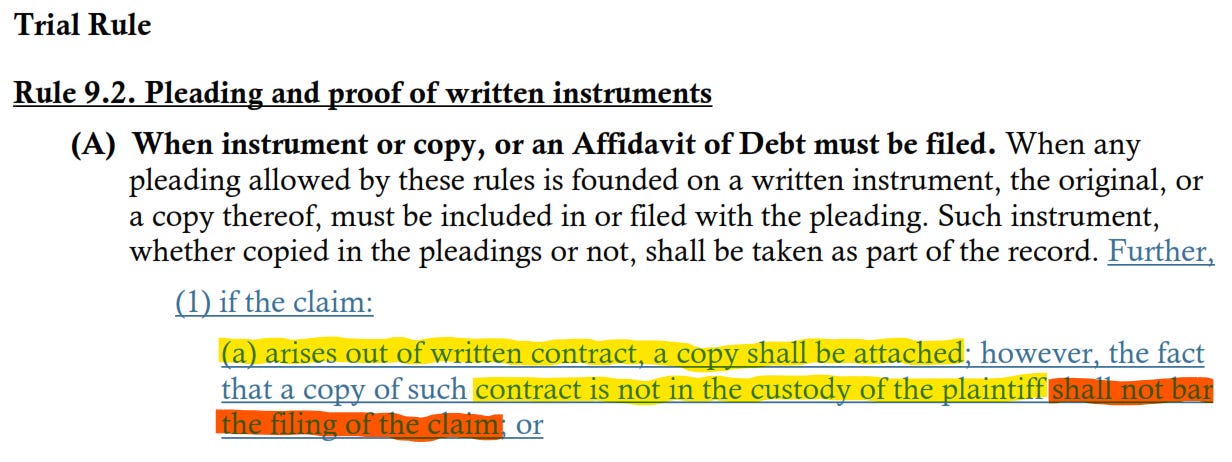
There is a final, systemic irony to this chapter of the record. On March 15, 2017—in the exact window of time where I was actively pushing the trial court to enforce the rules and compel Valeo to produce a signed document—the Indiana Supreme Court Committee on Rules of Practice and Procedure proposed major revisions to Trial Rule 9.2.
They added a critical, telling clause (in bold):
“...if the claim arises out of a written contract, a copy shall be attached; however, the fact that a copy of such contract is not in the custody of the plaintiff shall not bar the filing of the claim;”
Look closely at the grammar of that amendment. Why would the highest court in the state explicitly need to carve out a new safe-harbor rule stating that a plaintiff’s lack of contract custody shall not bar the filing of a claim?
Under standard principles of statutory interpretation, the addition of this phrase is a confession of how the unamended rule operated. If the Supreme Court had to create a brand-new procedural exception to protect plaintiffs who do not possess a copy of the contract they are suing on, it heavily implies that prior to this change, failing to attach a complete contract did bar the claim from being filed.
For two years, I stood in court as a pro se litigant asserting that Valeo was in total default of Trial Rule 9.2 because their “Entire Agreement” was contractually inseparable from a Compensation Agreement they did not possess. I argued the case was legally un-triable because they lacked the full four corners of the document.
Chief Justice Loretta Rush formally signed this rule change into the books on October 31, 2017—just over two months after the trial court used an unsigned, “assembled” photocopy to hand Valeo its judgment.
The Supreme Court delayed the implementation of the new rule until January 1, 2020. Because of that strategic window, Valeo’s lawsuit was finalized at the precise moment in Indiana legal history where a billion-dollar litigator could still convince a trial court to ignore a missing contract component, right before the high court permanently stepped in to close the door.
Another statistical impossibility like House Bill 1469 in Part 9 over $33,627.75.
__________________________
In Part 12, I will share how Valeo’s attorneys took advantage of a very challenging and dangerous situation just to avoid answering a simple question.

No comments:
Post a Comment