In Part 11, I detailed the black-letter reality of Indiana Trial Rule 9.2 and the deep disconnect between the courtroom record and the final written judgment. But a pro se, self-represented defendant does not simply wake up one morning with clear evidence of an opponent’s contract default. To uncover the fact that Valeo was litigating without a signed contract, I had to build a specific diagnostic mechanism.
And when I deployed it, the firm’s counsel responded by weaponizing a medical crisis.
The Diagnostic Lever (Trial Rule 9.2)
By the fall of 2016, I was trapped in a highly unequal legal war. I had already stood in open court during our very first venue hearing and explicitly warned the judge that the contract anchoring the lawsuit was structurally incomplete because the integrated Compensation Agreement was entirely missing. As I stated on the record at the time:
“The copy you have there is missing some of the language because you find page seven, paragraph or sub paragraph F, entire agreement... and you’ll note that there is no compensation agreement included...”
The court did absolutely nothing in response to those continuous, formal challenges. Every objection was overruled in favor of Valeo’s motions.
Left with no judicial oversight, I had to find a procedural lever to compel an answer. On September 21, 2016, I filed a formal Request to Inspect the Original Instrument under Trial Rule 9.2(E).
Let me be perfectly clear: I did not care about physically handling a piece of paper. The inspection request was a forensic test. It was the only procedural mechanism I could figure out to force Andrew Hull to break his silence and state a binary truth on a permanent record: Does an executed contract exist, or doesn’t it?
To eliminate any excuses for delay, I built a literal safe harbor directly into the text of the filing. Under Paragraph 20 of my request, I explicitly stated that if a physical meeting could not be arranged before the legal deadline, Valeo could completely satisfy the requirement by simply mailing a copy of the instrument accompanied by a signed, notarized affidavit attesting to its completeness and validity.
If they possessed a valid, signed agreement, complying would have taken their team less than five minutes. Instead, they chose to initiate a months-long procedural stall.
The Strategy of Non-Representation
A frequent question I receive is why I didn’t simply hire an attorney at the outset of the case. Having studied Andrew Hull’s high-profile caseload—including his concurrent representation of IBM against the State of Indiana in a $1.3 billion dispute—I knew his standard operating strategy was to overwhelm smaller opponents with a continuous barrage of scorched-earth procedural motions.
Had I hired a local attorney from the beginning, their mounting billable hours would have quickly placed me in an impossible financial position, forcing a rapid liquidation of my family’s remaining resources before an Indianapolis venue. I was not acting as a hapless novice; I spent countless hours researching state templates and mapping out a strict defensive calculus.
My plan was disciplined: use the trial rules to force Valeo to cure their structural default on the contract first. Once they committed a genuine, signed instrument to the record, I could bring in an attorney to execute the heavy lifting.
But as I waited for their mandatory response, my physical health collapsed.
___________________________
October 23, 2016: The Crash on State Road 15
In late September, I was hit with a severe chest infection that aggressively dragged on for weeks. Operating as a self-represented litigant, I knew I could not afford to project any vulnerability to an elite corporate firm, so I kept the severity of the illness private.
On Sunday, October 23, 2016, the medical situation became an emergency. Driven by the extreme financial strain brought on by this litigation, I had begun handling increasingly major mechanical repairs on our family vehicles myself. Feeling slightly better that morning, I finished swapping out a parking sensor on my wife’s GMC Yukon and took it out for a brief, one-mile test drive on State Road 15—a busy, heavily trafficked state highway near our house.
As I was heading back home, a violent, uncontrollable coughing fit overtook me. The sheer physical pressure triggered what doctors call cough syncope—a sudden loss of consciousness caused by a brief stoppage of the heart, cutting off the blood supply to the brain.
I blacked out instantly. The driverless vehicle ran off the side of the road, smashed violently into a high-voltage telephone pole, bounced completely over a massive boulder, and came to a rest a few feet away from a major fiber-optic junction.
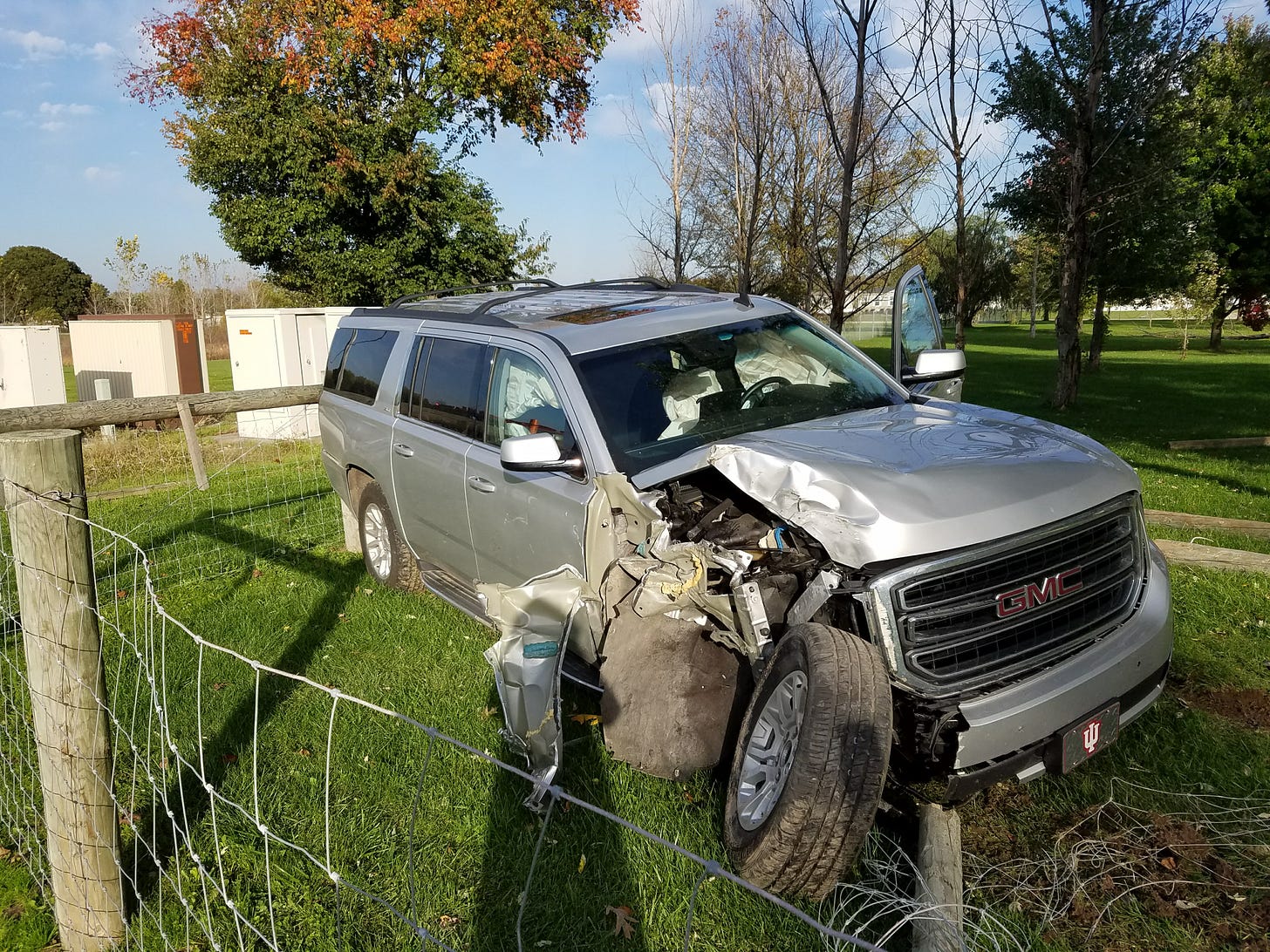
When I regained consciousness, the vehicle was completely totaled. Aside from a minor first-degree burn on my arm from the airbag, I walked away physically intact but deeply shaken. I was profoundly thankful not to have drifted across the center line into oncoming afternoon traffic during busy afternoon traffic. Though I was uninjured, I was consumed by a profound fear of getting behind the wheel—terrified that another coughing fit could cause a catastrophic accident and injure someone else.
The very next day, October 24, 2016, I sent a direct email to Andrew Hull. I was entirely transparent, explicitly detailing the crash, with pictures, and explaining that I was physically incapacitated and unable to make the three-hour drive down to their Indianapolis offices.
___________________________
The Evasion Match
With the explicit, written knowledge that I was physically stranded three hours away, Hull’s office deployed their containment strategy.
I repeatedly notified them via email that an arduous physical trip to Indianapolis was entirely unnecessary, pointing them directly back to the mail-in safe harbor already built into Paragraph 20 of my filing. I asked a single, direct question: Does the document you are offering for inspection include an executed, signed copy of the Compensation Agreement?
The response from Andrew Hull and his associate was a masterclass in calculated evasion. Across the email thread, I asked that exact single-sentence question four separate times. Four separate times, they completely refused to write the words “yes” or “no”.
Instead, they returned pages of rigid legal prose, endlessly repeating the same clinical line: The documents are available for inspection at our office in Indianapolis during normal business hours.
They knew I could not drive. They knew I was physically isolated. Yet they aggressively insisted on a physical meeting as a mandatory prerequisite to answering a basic query about their own pleading, using my medical confinement as a tactical shield to run out the case management clock.
___________________________
The December 14 Courtroom Reality
The culmination of this evasion played out on the record during our Case Management Conference on December 14, 2016. I stood in front of the judge and explicitly read their months of non-answers into the permanent record of the court:
MR. COATES: “Part of the problem has been that I’ve made 1-2-3-4-5-6-7-8, filings addressing the fact that there isn’t a [compensation] agreement in formal filings to the court. I sent 1-2-3-4-5-6-7-8-9-10, 11 emails to Valeo’s counsel asking for compensation agreements. And of course, one of those was the request to inspect.”
Instead of requiring the plaintiff to provide a transparent answer regarding the missing foundational contract of their own lawsuit, the judge excused the firm’s silence, telling me from the bench that discovery was simply a hyper-technical game:
___________________________THE COURT: “The trial rules talk about how you get discovery, and so if you don’t ask it for in that fashion, then another party doesn’t have the obligation, right? And it’s rather formalized process.”
The True Stakes
As far as my personal assets were concerned, this was never a multi-million dollar lawsuit; it was a localized $33,627.75 fee dispute over six clients. But for Valeo’s ownership, the systemic financial exposure was easily worth millions, potentially hundreds of millions today.
Exposing the fact that they did not possess a signed 2010 Compensation Agreement was a massive threat. If an industry advisor with a compliance background successfully proved that their quarter-over-quarter “Performance Standards Adjustments” were actually illegal wage fines engineered to offset the firm’s financial turmoil, the signed contracts of their entire advisor force would be instantly jeopardized.
Every younger advisor—who clearly met the legal definition of an employee—would possess immediate standing to walk out the door with their client books with zero legal recourse for Valeo. Furthermore, a class-governed wage violation carried mandatory misdemeanor disclosures that could permanently end the firm’s regulatory approval to manage high-net-worth capital.
I was likely never the primary target of this multi-year onslaught; I was simply the tool. This appears to be a deterrent suit, designed to spend whatever corporate resources were necessary to make an aggressive example out of an industry veteran, signaling to the rest of their staff the absolute ruin that awaited anyone who attempted to challenge the internal model. If so, Valeo has succeeded - a point we will get to much later.
By weaponizing a serious accident and a respiratory illness, they successfully concealed the absence of a signed agreement until my procedural window to respond to summary judgment had closed. They ran out the clock in the dark, ensuring the fundamental flaw of their entire action remained entirely hidden until they could claim that it was too late to save my defense.
___________________________
In Part 13 we return to the June 28, 2017 meeting. After Valeo’s lead counsel admitted there was no signed Compensation Agreement, he told me there would be no more responses to summary judgment because the briefing was already over.


No comments:
Post a Comment