In Part 5, I shared the moment when Andrew Hull, lead counsel for Valeo, admitted face-to-face that the Compensation Agreement they were suing me over never existed. It had taken two years of litigation and persistent questioning to reach that simple fact.
But there was another fact I completely missed in 2015—one that should have told me exactly how high the stakes really were.
The IBM Attorney
In 2015, Valeo didn’t just hire a local litigation attorney. They hired Andrew Hull.
At that exact moment, Mr. Hull was deep in the middle of representing IBM in its $1.3 billion dispute with the State of Indiana and related cases—arguably the highest-stakes litigation in the history of the state. Here’s Hull’s IBM cases only in Indiana courts since 2015.
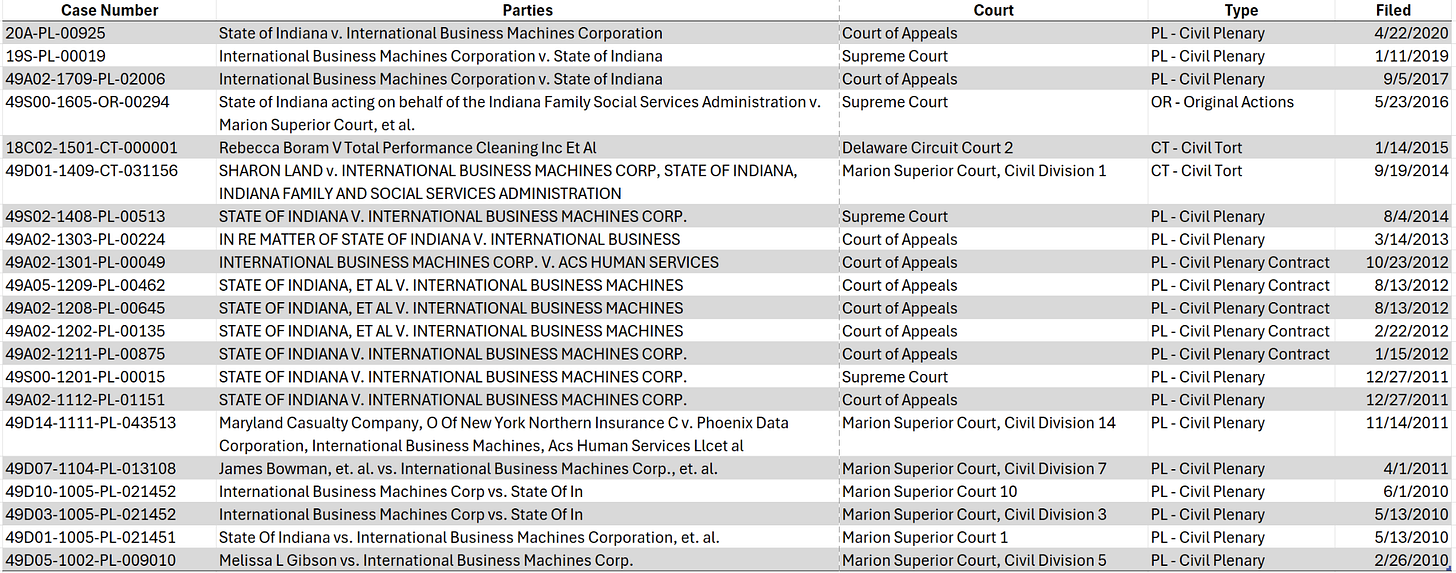
Hull was the person major corporations turned to when billions were on the line. Beyond IBM, Mr. Hull’s portfolio of high-stakes litigation includes cases involving some of the most recognizable names in the country:
The National Football League, The Indianapolis Colts
Netflix, Dish Network
Alex Palou, Chip Ganassi Racing
BASF, Cummins, Hitachi, Starbucks
Why did a firm with roughly 20 advisors feel the need to hire the biggest-name litigation attorney in Indiana to pursue a $33,627.75 claim over a handful of “sub-target” clients? And why did an attorney who litigates billion dollar contracts and deposes governors, agree to take a case so far beneath his reputation?
The Disconnect
I missed it. At the point the lawsuit was filed, my own financial situation was dire. I had been open with Valeo about the fact that I was resigning to avoid bankruptcy and to cut my family’s health insurance costs in half through the newly established ACA exchanges.
Bankruptcy is a required disclosure with the SEC and the CFP Board—a regulatory “black mark” I assumed the firm would want to avoid as much as I did. Because of our open communication, the firm had every reason to know that I could not afford an attorney for any material period of time—especially not a capable one, and certainly not one in Indianapolis.
I was so focused on the survival of my family that I didn’t see the significance of the man sitting across from me.
_______________________
The Expert’s Dilemma
From my perspective as a former regulatory Chief Compliance Officer, I always believed that the specifics of whatever contract or agreement Valeo claimed we had didn’t actually matter because I believed the “Performance Standards Adjustments,” were wage fines, illegal under Indiana law, controlled the situation.
From my first court filing on June 1, 2015:
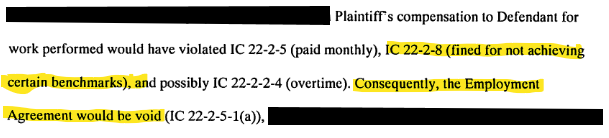
I never wavered from that position.
I only needed to pin down the agreement to know which legal path to take:
Did Valeo breach the terms of a valid contract without a provision for wage fines?
Or was the contract itself illegal because it contained wage-fine provisions?
I spent two years trying to solve that riddle.
_______________________
In Part 7, I’ll describe the discovery I made on June 6, 2017—the day that Hull’s aggressive claims led me to a digital search through years of old backups. I uncovered something that changed everything.

No comments:
Post a Comment