When Everything Changed...
In Part 6, I highlighted the disconnect of facing a “billion-dollar litigator” over a relatively small claim. At the time, I was a self-represented defendant trying to solve a riddle about which legal path to take. But by May 2017, the riddle was being replaced by a much more immediate threat: procedural sabotage.
The Pressure to Produce
For months, the firm’s counsel had been hitting me with formal accusations of “withholding” information and “retaining” Valeo documents. By May 10, 2017, the firm escalated the situation by filing a Motion for Discovery Sanctions.
The accusations were serious:
Spoliation of Evidence: They argued I had not properly explained the “shredding in the snow” detail they were only now claiming to hear about.
Withholding Documents: They claimed I was hiding files under “invalid” claims of privilege.
The “Blindfold”: Most importantly, they asked the court to preclude me from offering any evidence in my own defense against their Motion for Summary Judgment.
The message was clear: if I didn’t “find” what they claimed I was hiding, I would be legally blindfolded for the rest of the trial.
The “Lost” Affidavit
This pressure was built on a very specific claim: that Hull had never received my explanation of the documents I had destroyed.
On September 21, 2016, I had filed and served to Hull’s office three distinct items in a single envelope, including:
The formal request to inspect the “Entire Agreement,” that they evaded admitting did not exist until that July 2017 meeting
A sworn Affidavit detailing how I properly destroyed Valeo client information I could not after my resignation. Not evidence. Client information.
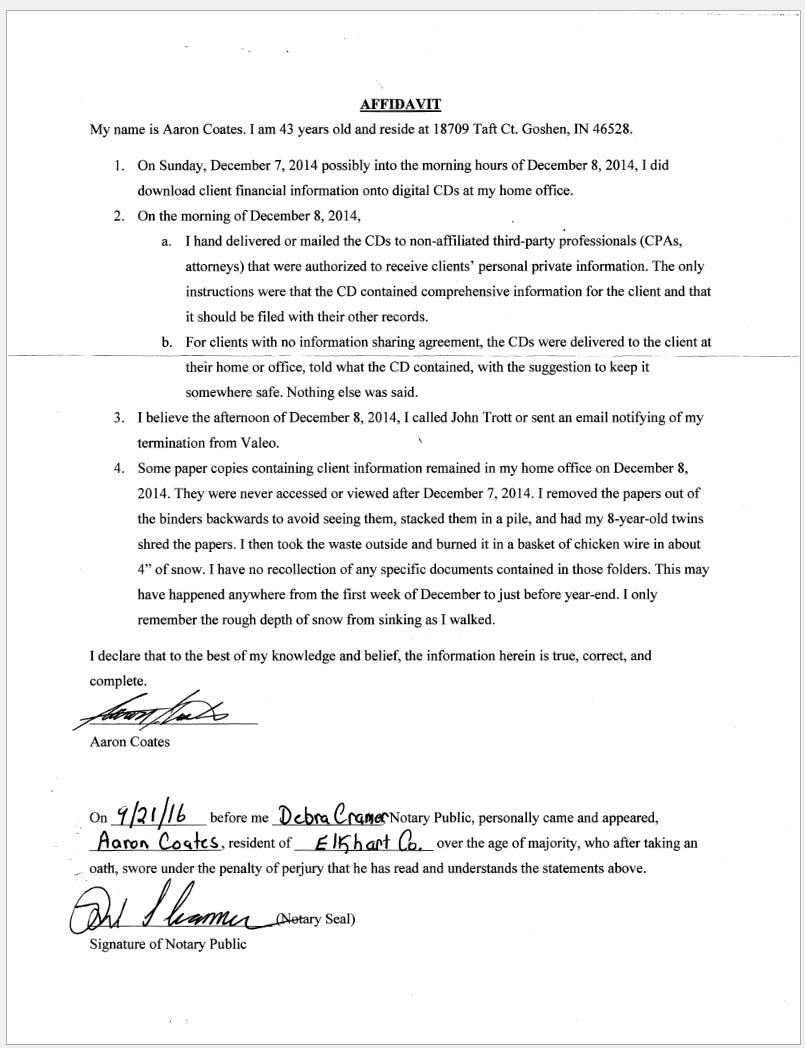
A notarized affidavit, including my recollection of snow depth.
Nine months later, here’s 30 seconds from that June 2017 meeting:
I then showed Hull an image of the affidavit.
“I’ve never seen that.”
This was the disconnect: Valeo’s lawyers acknowledged receiving the other two documents from that same envelope. More importantly, that affidavit wasn’t just mailed; I filed it with the court. It was public record, accessible to them as attorneys through the court web portal. AND available to the court.
Now Hull had seen it. On my computer.
Then I e-mailed him another copy at his request.
He had a duty to admit his error to the court.
Even right after learning the truth of his two years of games regarding the non-existent Compensation Agreement, I expected him to be forthcoming to the court about this.
He wasn’t.
_____________________________
At the July 2017 Hull continued to claim that he “didn’t know” as the as the basis for seeking the sanctions. I tried to share my side.
The Court awarded sanctions against me denying me the right to offer any evidence.
All based on a lie.
The billion-dollar litigator, taking serious professional risk over $33,627.75?
June 6, 2017: The Deep Search
Before that hearing, under the threat of being unable to defend myself, I spent June 6, 2017, performing an exhaustive search of every digital backup I possessed. I dug through old thumb drives and backup CDs, looking for anything that could satisfy their demands. Then I wondered if online document storage from 2009, prior to merging with Valeo, was still active in 2017. It was.
That is when I found the “Receipts.”
A digital folder contained Valeo’s internal management PowerPoint presentation from April 2009. It had been provided to me by Valeo prior to the merger so I could use the template for upcoming professional speaking engagements that were likely to happen after the contemplated merger.
That branding template had records of a Finance Committee and Management Committee meeting from months before I had even made my first inquiry to the firm.
The Pivot
The title date, April 18, 2009, was a Saturday. I was beginning to realize the magnitude of what I had found, but I had no idea of the full scope. I didn’t yet have access to Hull’s attorney invoices or notice a statistical impossibility of the timeline regarding an Indiana law from 2015.
On June 15, 2017, I produced this document to Hull’s office. I showed that these records showed management had agreed to include a “performance fine” before I even joined.
The tone of the litigation changed almost immediately.
The lawyer that had spent two years claiming I was “withholding” documents was now faced with the fact that I had the internal record of Valeo’s intent. They needed to do whatever necessary to keep me from producing that evidence on the record. Now you get to see it, and why it matters.
_____________________________In Part 8, I’ll reveal the “Inside Story” contained within those PowerPoints—Valeo’s financial desperation following 2008 and the “existential save” that explain why this lawsuit was happening.


No comments:
Post a Comment